
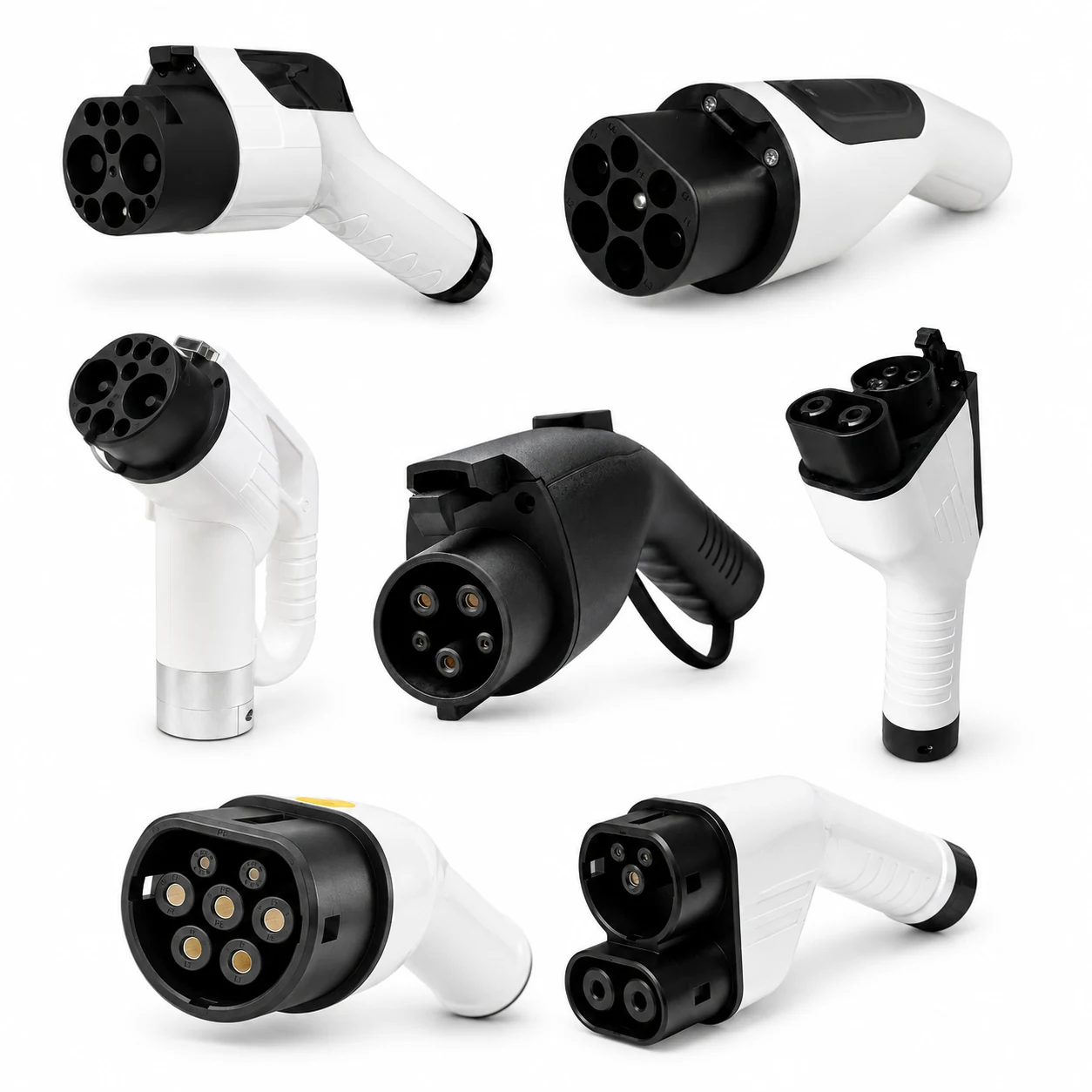
The Combined Charging System (CCS) integrates AC charging contacts and additional high-current DC contacts within one vehicle-interface family. CCS1 and CCS2 serve the same basic purpose, but they are built on different AC connector foundations and therefore differ in geometry, regional deployment and mating vehicle inlet. A sourcing request should never specify only “CCS”; the destination market, vehicle inlet and applicable standard must also be confirmed.
1. Different connector foundations
CCS1 is generally based on the Type 1 / SAE J1772 AC interface with two added DC contacts below it. CCS2 is based on the Type 2 / IEC 62196-2 AC interface and also adds two high-current DC contacts. Their mechanical geometry is different, so the connectors are not directly interchangeable.
2. Regional deployment differs
CCS1 is primarily associated with vehicles and charging infrastructure in North America. CCS2 is widely used in Europe and in many export markets following IEC-based interfaces. Always verify local regulation, vehicle platform and charging-operator requirements because regional adoption can change with models and policy.
3. Parameters to confirm before sourcing
Beyond the interface standard, confirm whether the requirement is a connector or vehicle inlet, rated current and voltage, cooling method, cable specification, mounting direction, ingress protection, temperature range and target certification. A rating must be verified for the complete assembly and operating condition, not inferred from connector appearance.
4. Sourcing conclusion
CCS1 and CCS2 are different interface ecosystems, not higher and lower performance grades. The correct choice depends on the target vehicle, regional standard and project parameters. For an efficient quotation, provide an inlet photo or drawing, interface standard, ratings, quantity, destination market and mounting requirement.